Chemistry also has much to tell us about the Universe. In a new edition of Charlas Spaceport MX, Dr. Alejandro Guerrero Caicedo will take us on a fascinating journey from organic synthesis to astrochemistry, exploring how this field helps us understand the processes that take place beyond our planet. 🌌🔭
🚀 We look forward to seeing you!
📅 Thursday, September 10
🕢 7:30 p.m. — Mexico
🕣 8:30 p.m. — Colombia
🔴 Live broadcast on Spaceport MX’s social media channels.


When a Chemist Looks to the Sky: From Organic Synthesis
to Astrochemistry
Explore how planetary exploration and the search
for biosignatures


What can the Solar System reveal about the possibility of life beyond Earth? In this lecture, Ph.D.(c) David Tovar will explore how planetary exploration and the search for biosignatures help us investigate the habitability of worlds across our planetary neighborhood.
From spacecraft and remote sensing to the study of organic molecules and planetary environments, the search for signs of life brings together planetary science, astrobiology, geology, and chemistry in one of the most fascinating questions in modern science: Are we alone? 🪐🧬
🎙️ Speaker: Ph.D.(c) David Tovar
Co-Director, Grupo de Ciencias Planetarias y Astrobiología (GCPA)
President, EuroPlanet Colombia
Join us and explore how we search for the fingerprints of life across the Solar System. 🚀✨
📍 Venue: Universidad de Ingeniería y Tecnología (UTEC) — Lima, Peru
📅 Date: Tuesday, September 22
🕒 Time: 3:00 p.m.
💻 Format: Hybrid
Endolithic Microorganisms in Mafic and Ultramafic Rocks of Gorgona Island: An Astrobiological Perspective
Speaker: David Tovar – Planetary Geologist and Astrobiologist – Professor at Universidad Distrital Francisco José de Caldas and President of EuroPlanet Colombia
This lecture explores the diversity of endolithic microorganisms inhabiting the mafic and ultramafic rocks of Gorgona Island, including its distinctive komatiites. From a geomicrobiological and astrobiological perspective, the talk will examine their survival strategies, interactions with the mineral substrate, and their potential as terrestrial analogues for understanding the habitability of extreme environments and the possible presence of microbial life on Mars, past or present.
📅 Date: Thursday, August 27
📍 Venue: Auditorio Fundadores – Virtual
🕘 Time: 9:45 a.m.


2nd Microbiology Meeting – EMIC 2026
2nd Microbiology Meeting – EMIC 2026


Extreme Environments and Their Ecology: The Key to Astrobiology
Speaker: María Angélica Leal – Astrobiologist – Professor at Universidad Distrital Francisco José de Caldas and Executive Director of CorpoLaguna
This lecture explores Earth’s extreme environments and the organisms capable of inhabiting them, examining the adaptations and ecological interactions that enable life to persist under extreme conditions. From an astrobiological perspective, the talk will address how the study of these ecosystems contributes to understanding the limits of habitability, identifying potential biosignatures, and guiding the search for life on Mars and other bodies within the Solar System.
📅 Date: Thursday, August 27
📍 Venue: Auditorio Fundadores – Virtual
🕙 Time: 10:15 a.m.
Biogeochemical Cycles in the Deep Subsurface of the Iberian Pyrite Belt: Astrobiological Implications
🌍🔬 Can life exist deep beneath Earth’s surface without sunlight?
Far beyond the surface, the deep subsurface hosts ecosystems where microorganisms can survive by taking advantage of the energy available in rocks and the chemical reactions occurring within them. The Iberian Pyrite Belt, in southwestern Europe, provides one of the most fascinating environments for studying these forms of life and the processes that sustain them.
This extreme environment is home to microbial communities capable of participating in interconnected carbon, hydrogen, nitrogen, sulfur, and iron biogeochemical cycles, including processes that operate in the absence of sunlight and under anoxic conditions. Understanding these systems not only helps us explore how life functions deep within our own planet, but also provides valuable clues about where and how we might search for life on other worlds. 🧬🪨🌌
The study of Earth’s deep subsurface therefore has a direct connection to astrobiology: environments such as the Iberian Pyrite Belt can serve as terrestrial analogues for investigating potential subsurface ecosystems on planetary bodies such as Mars. 🔴🚀
Join us for Workshorts EuroPlanet Colombia 2026 and the lecture:
🎙️ “Biogeochemical Cycles in the Deep Subsurface of the Iberian Pyrite Belt: Astrobiological Implications”
A conversation exploring how life can adapt to some of the most extreme environments on Earth—and what these hidden ecosystems may reveal about the possibility of life beyond our planet. 🌎➡️🪐
📅 Friday, August 28, 2026
🕛 12:00 p.m. — Colombia | 2:00 p.m. — Argentina
💻 Virtual Event


Molecules Among the Stars


In our upcoming edition of Charlas Spaceport MX, we will journey into the fascinating world of astrochemistry with Dr. Heidy Quitián-Lara, a chemist with a Ph.D. in Astronomy who specializes in astrochemistry and molecular astrophysics. 🌌🔬
She is currently conducting postdoctoral research at the Center for Astrochemical Studies at the Max Planck Institute for Extraterrestrial Physics in Germany, where she investigates how molecules form, evolve, and survive under the extreme conditions of space.
🚀 During this talk, we will discover that the universe is far from empty: between the stars lies a remarkable world of chemistry that can help us understand the origin and evolution of matter throughout the cosmos.
Because exploring the universe also means understanding the chemistry taking place millions of kilometers away from us. 🌌
📅 Thursday, August 13
🕑 2:00 p.m. (Mexico time)
🔴 LIVE on Spaceport MX’s social media channels
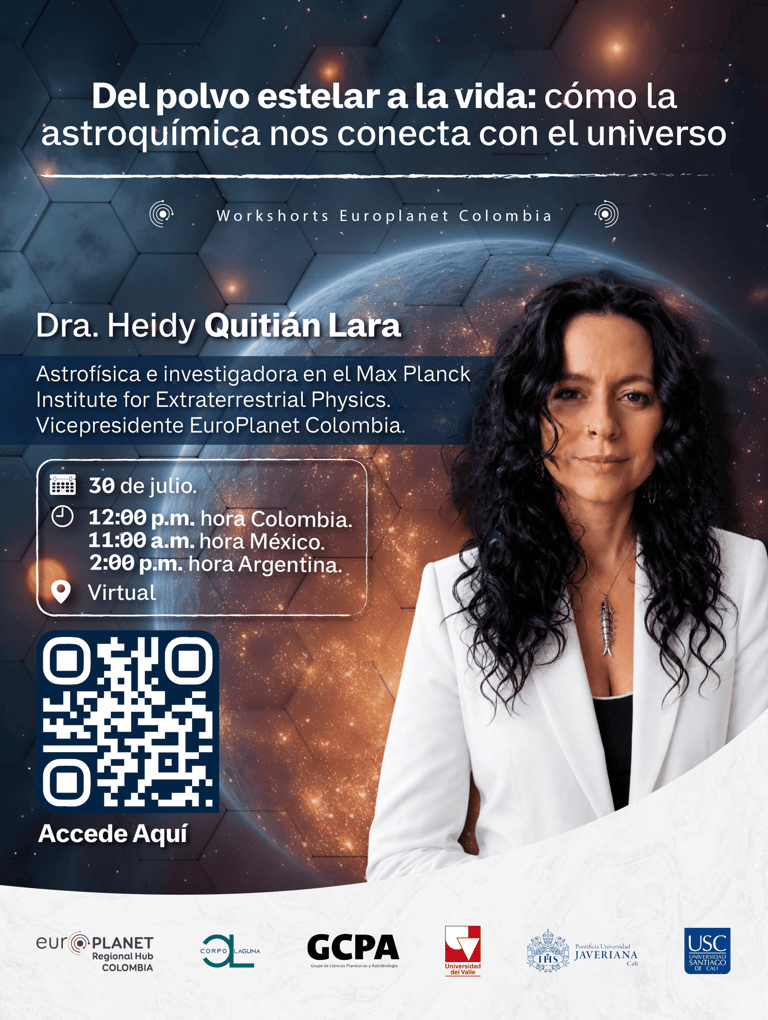
From Stardust to Life: How Astrochemistry Connects Us
to the Universe
🚀✨ Did you know that the atoms that make up your body were once forged within the stars? Astrochemistry helps us understand how the elements and molecules of the Universe gave rise to the fundamental building blocks of life. 🌌🧬
We invite you to join the lecture "From Stardust to Life: How Astrochemistry Connects Us to the Universe," presented by Dr. Heidy Quitián Lara, astrophysicist, researcher at the Max Planck Institute for Extraterrestrial Physics, and Vice President of EuroPlanet Colombia. In this inspiring talk, she will guide us through the remarkable connection between the chemistry of the cosmos and the origins of life itself. ⭐🔬
Scan the QR code in this post to register and join us for a fascinating discussion exploring how, quite literally, we are made of stardust. 🌠💙
📅 July 30
🕛 12:00 p.m. (Colombia)
11:00 a.m. (Mexico)
2:00 p.m. (Argentina)
💻 Virtual Event
SYMPOSIUM: ADVANCES IN ASTROBIOLOGY AND SPACE EXPLORATION
The IEEE Aerospace and Electronic Systems Society (AESS) – UNMSM cordially invites you to participate in this academic symposium dedicated to exploring the latest developments in astrobiology and space exploration.
Over the course of two sessions, experts will share their knowledge, experiences, and perspectives on the search for life in the universe, the conditions that enable the habitability of other worlds, the most significant contemporary space missions, and the technologies that are transforming our understanding of the cosmos.
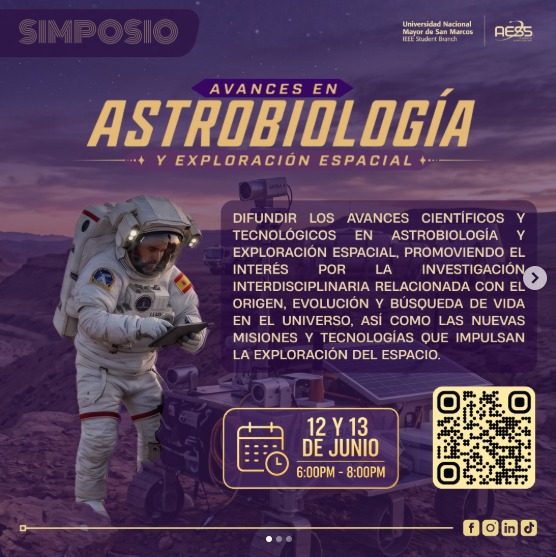
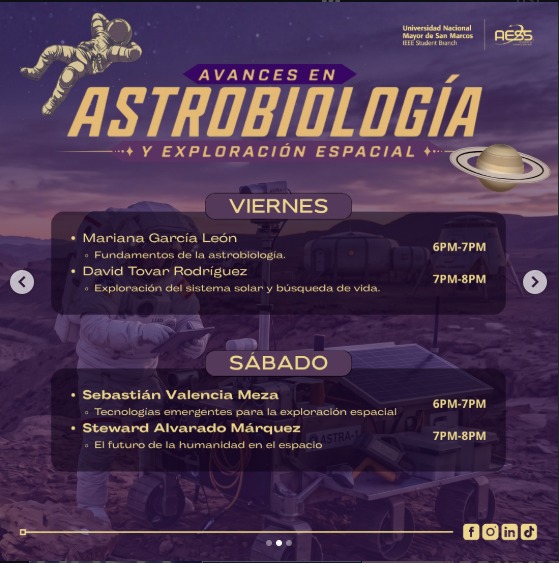
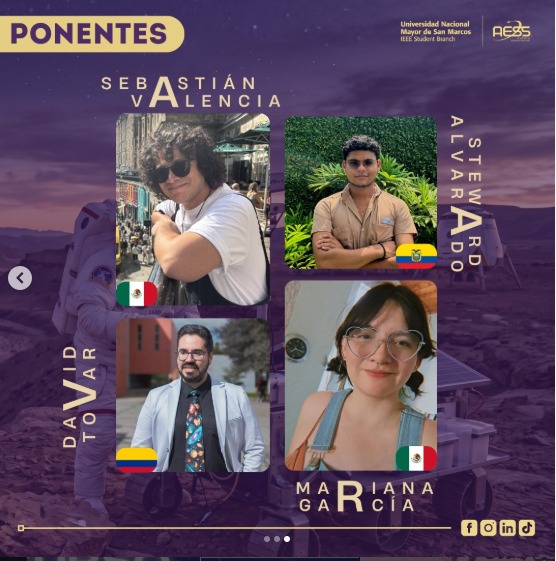
📅 Dates: Friday 12 and Saturday 13 - June
🕕 Time: 18:00 – 20:00 (GMT-5)
👥 Target Audience: Students, faculty members, researchers, and members of the general public with an interest in space sciences.
The Moon: A Silent Architect of the History and Evolution
of Life Synopsis.


For over 4.5 billion years, the Moon has been much more than a bright object in the night sky. Since its origin in a giant impact that transformed the early Earth, it has influenced fundamental processes such as the stabilization of Earth's rotational axis, the generation of tides, ocean dynamics, and the evolution of ecosystems. These interactions have shaped the planet's climate, the biological rhythms of countless organisms, and some of the most momentous events in evolutionary history, including the colonization of land. Through a journey through geological time, this lecture will explore how the relationship between Earth and the Moon has helped shape the biodiversity we know today and why our satellite can be considered one of the silent protagonists in the evolution of life.
PhD in Evolutionary Biology and Paleontology – Complutense University of Madrid. Member of Europlanet Colombia Research Professor, Leader of the Research Group in Ecology and Biodiversity Conservation - Santiago de Cali University. Member of the Research Team in Paleoclimatology, Macroecology and Macroevolution of Vertebrates (UCM, CSIC), Spain. Member of the Cali School of Astronomy and Leader of the AstroLUCA Research Group: Astrobiology Line.
Further information about SLL at:


Gorgona Island as a Geochemical Analog of the
Syrtis Major Region on Mars
We continue with the SOMA Online Lecture Series: Let's Talk About Astrobiology.
On this occasion, we will be joined by an expert in terrestrial analog environments, Ph.D. Candidate David Tovar, member of the Latin American Astrobiology Network, Co-Director of the Planetary Sciences and Astrobiology Group (GCPA), and President of Europlanet Colombia. He will deliver a lecture entitled:
"Gorgona Island as a Geochemical Analog of the Syrtis Major Region on Mars"
Access the event through the following link:
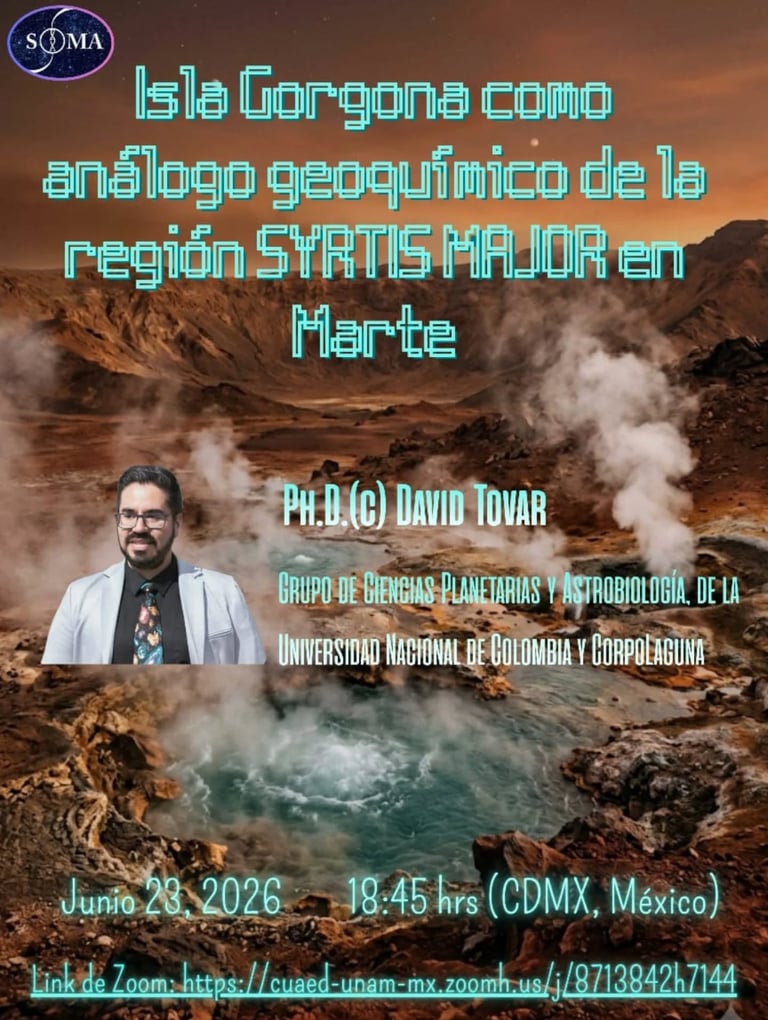
📆 Tuesday, June 23
🕗 18:45 hrs (Mexico City Time, CDT)
📍 Virtual
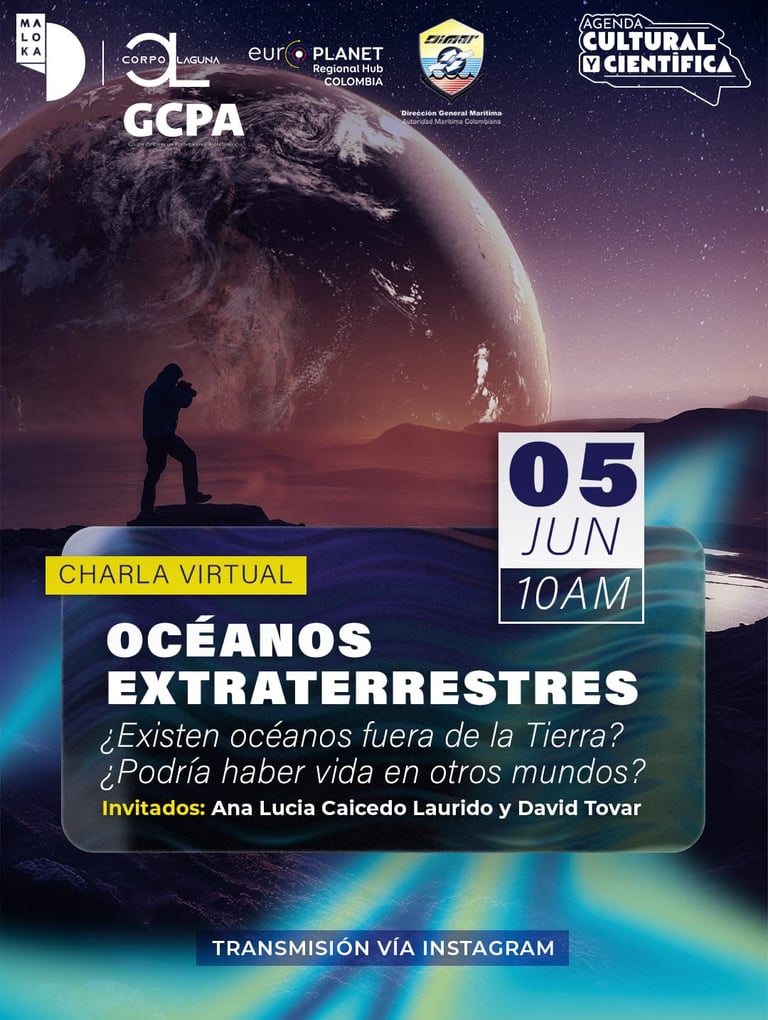
📆 Friday - June 5 2026
🕗 10:00 - 11:00
📍 Virtual - Instagram @malokabogota
Extraterrestrial oceans are large bodies of liquid water (either saline or freshwater) that exist on other celestial bodies within the Solar System, such as the moons of Jupiter and Saturn, as well as on exoplanets. Unlike Earth's oceans, most of these extraterrestrial oceans are concealed beneath thick layers of ice, making them prime targets in the search for extraterrestrial life, including microbial and extremophilic organisms.
NASA scientists are actively searching for signs of life in environments such as Europa (a moon of Jupiter) and Enceladus and Titan (moons of Saturn), where vast subsurface oceans are believed to exist, maintained in a liquid state through gravitational and tidal heating. In addition, astronomers have recently identified a new class of exoplanets known as Hycean worlds—water-covered planets with hydrogen-rich atmospheres that may possess conditions suitable for supporting life.
Speakers
Ph.D. ANA LUCÍA CAICEDO LAURIDO
Head of Scientific Research, Technological Development, and Maritime Innovation.
Dr. Caicedo Laurido holds a Ph.D. in Marine Sciences from Jorge Tadeo Lozano University and a Master's degree in Oceanography from the Almirante Padilla Naval Academy in Cartagena. She has additional training in Public Management, Governance, and Political Leadership. She participated in the Third Colombian Scientific Expedition to Antarctica and was recently awarded the Military Medal “Antarctic Spirit” in recognition of her contributions to Antarctic research.
She has extensive experience in the design, coordination, and implementation of interdisciplinary scientific research, technological development, and maritime innovation projects. She has represented Colombia in numerous national and international committees, including the Southeast Pacific Regional Workshop within the framework of the United Nations Decade of Ocean Science for Sustainable Development.
Ph.D. (c) DAVID TOVAR
David Tovar is a Colombian planetary geologist and astrobiologist with professional experience in planetary sciences, volcanology, terrestrial analogues, extreme environments, and geological mapping. His research focuses on evaluating the geological, geochemical, and geomorphological characteristics of diverse locations around the world in order to classify them as planetary analogues. As part of this work, he also conducts research in geobiology and geomicrobiology, with a particular emphasis on extremophilic and extremotolerant microorganisms, as well as biogeochemical cycles, for their application in astrobiological studies.
Additionally, he is Associate Researcher with the Colombian Antarctic Program, Co-Director of the Planetary Sciences and Astrobiology Research Group (GCPA) at the National University of Colombia, Scientific Director of the LAGUNA Scientific Corporation, and President of Europlanet Colombia.
UNUSUAL CONVERSATIONS – Virtual
Extraterrestrial Oceans